
25 Powerful Bible Verses About Investing Money Wisely

Investing is not just about growing money — it is also about wise stewardship. While the Bible does not mention stocks or modern investments directly, it offers timeless principles about planning, diligence, wealth, and financial wisdom. These Bible verses about investing can help Christians make smart financial decisions while keeping their trust in God rather than money.
Does the Bible Talk About Investing?
Many people wonder, “What does the Bible say about investing?” Although the Bible was written long before the modern stock market existed, Scripture contains many powerful teachings about money management, stewardship, saving, wealth building, and financial wisdom.
Biblical investing is not about greed or chasing riches. Instead, the Bible encourages believers to manage resources wisely, plan for the future, work diligently, and avoid reckless financial decisions. These timeless principles can help Christians make wise investment choices while honoring God.
Throughout Scripture, we see examples of:
- Planning ahead for future needs
- Multiplying resources responsibly
- Diversifying possessions
- Avoiding dishonest gain
- Trusting God instead of wealth
The Bible also teaches that money itself is not evil. Rather, it is the love of money that can lead people away from God. Wise investing combined with faith, generosity, and stewardship can be a responsible way to provide for your family and future.
Below are some of the most important Bible verses about investing, wealth, and financial stewardship.
Bible Verses About Investing
Here are best Bible Verses About Investing with the meaning and the use of life.
Matthew 25:14–30 — The Parable of the Talents
“Well done, good and faithful servant!” — Matthew 25:21 (NIV)
This parable teaches the importance of wise stewardship and using resources responsibly instead of letting them go unused.
Ecclesiastes 11:2 — Diversification and Risk Management
“Invest in seven ventures, yes, in eight…” — Ecclesiastes 11:2 (NIV)
This verse encourages diversification and wise financial planning instead of putting everything into one place.
Proverbs 21:5 — Planning Leads to Profit
“The plans of the diligent lead to profit…” — Proverbs 21:5 (NIV)
The Bible teaches that patience, discipline, and careful planning are important for financial success.
Luke 14:28 — Count the Cost
“Won’t you first sit down and estimate the cost?” — Luke 14:28 (NIV)
Jesus highlights the importance of planning before making major financial or investment decisions.
Proverbs 13:11 — Wealth Built Slowly
“Whoever gathers money little by little makes it grow.” — Proverbs 13:11 (NIV)
Saving and investing are both important parts of biblical financial stewardship. While investing focuses on growing resources wisely, saving money helps Christians prepare for future needs, avoid unnecessary debt, and practice financial discipline. You can also read our guide on Bible Verses About Saving Money: 30 Powerful Scriptures on Financial Wisdom and Stewardship to learn more about what the Bible teaches about saving and wise money management.
Lasting wealth is often built gradually through patience, consistency, and wise financial habits.
1 Timothy 6:10 — Avoid the Love of Money
“For the love of money is a root of all kinds of evil.” — 1 Timothy 6:10 (NIV)
This verse reminds believers not to place wealth above faith in God.
Proverbs 3:9–10 — Honor God With Your Wealth
“Honor the Lord with your wealth…” — Proverbs 3:9–10 (NIV)
Christians are called to use money wisely, generously, and in ways that honor God.
Genesis 41:34–36 — Joseph’s Financial Planning
Joseph prepared Egypt for famine by saving resources during years of abundance.
This story highlights the importance of preparation, saving, and long-term financial planning.
Proverbs 15:22
“Plans fail for lack of counsel, but with many advisers they succeed.” — Proverbs 15:22 (NIV)
Wise investing includes seeking good advice and making informed financial decisions.
Proverbs 27:23–24
“Be sure you know the condition of your flocks…” — Proverbs 27:23 (NIV)
This verse teaches the importance of paying attention to finances, investments, and resources.
Luke 16:10
“Whoever can be trusted with very little can also be trusted with much.” — Luke 16:10 (NIV)
God values faithful stewardship, even with small amounts of money.
Proverbs 28:20
“A faithful person will be richly blessed…” — Proverbs 28:20 (NIV)
The Bible encourages patience and faithfulness instead of chasing quick riches.
Psalm 37:21
“The righteous give generously.” — Psalm 37:21 (NIV)
Biblical wealth should be connected to generosity and helping others.
Ecclesiastes 5:10
“Whoever loves money never has enough.” — Ecclesiastes 5:10 (NIV)
Money should never become the center of life or replace faith in God.
Proverbs 6:6–8
“Go to the ant… consider its ways and be wise!” — Proverbs 6:6 (NIV)
This verse encourages preparation, hard work, and planning for the future.
Hebrews 13:5
“Keep your lives free from the love of money…” — Hebrews 13:5 (NIV)
Christians should practice contentment while managing money wisely.
Proverbs 16:8
“Better a little with righteousness than much gain with injustice.” — Proverbs 16:8 (NIV)
The Bible values integrity more than dishonest financial success.
Matthew 6:24
“You cannot serve both God and money.” — Matthew 6:24 (NIV)
Investing should never become more important than faith and obedience to God.
Deuteronomy 8:18
“Remember the Lord your God, for it is he who gives you the ability to produce wealth.” — Deuteronomy 8:18 (NIV)
This verse reminds believers that financial blessings ultimately come from God.
Psalm 112:5
“Good will come to those who are generous and lend freely…” — Psalm 112:5 (NIV)
Wise financial management should include generosity and fairness.
Proverbs 10:4
“Diligent hands bring wealth.” — Proverbs 10:4 (NIV)
Hard work, discipline, and consistency are important biblical principles for wealth building.
Colossians 3:23
“Whatever you do, work at it with all your heart…” — Colossians 3:23 (NIV)
Christians should approach work, business, and financial stewardship with excellence and integrity.
Proverbs 22:7
“The borrower is slave to the lender.” — Proverbs 22:7 (NIV)
This verse warns believers to be careful with debt and financial dependence.
You can read the full chapter on Bible Gateway for additional context and study.

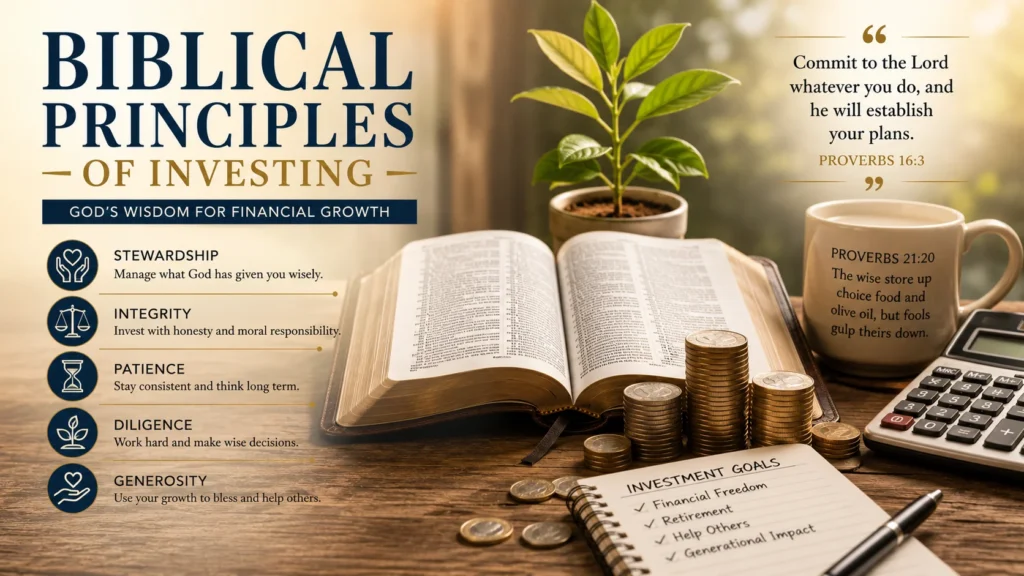
Biblical Principles of Investing
The Bible provides many timeless principles that can guide Christians in making wise financial and investment decisions. While Scripture does not specifically mention stocks, mutual funds, or retirement accounts, it clearly teaches how believers should handle money, wealth, and stewardship.
Here are some of the most important biblical investing principles Christians can follow today.
Stewardship Over Ownership
One of the biggest financial lessons in the Bible is that everything ultimately belongs to God. Christians are called to be stewards, not owners, of the resources God provides.
This means investing should be approached with wisdom, responsibility, and humility. Money is a tool entrusted to believers for providing for families, helping others, and honoring God.
Good stewardship includes:
- Managing money wisely
- Avoiding wasteful spending
- Planning for the future
- Using wealth responsibly
Diversification Is Wise
As seen in Ecclesiastes 11:2, the Bible supports the principle of diversification. Wise investors do not place all their resources into one opportunity because unexpected problems can arise at any time.
Diversification can help reduce financial risk and create greater long-term stability. Modern examples include spreading investments across:
- Stocks
- Real estate
- Savings accounts
- Businesses
- Retirement funds
Patience and Long-Term Thinking
The Bible repeatedly teaches patience, diligence, and consistency. Successful investing usually takes time, discipline, and careful planning rather than emotional decisions or risky shortcuts.
Long-term investing reflects biblical wisdom because it focuses on steady growth instead of chasing instant riches.
Avoid Greed and Dishonest Gain
Scripture warns against greed, dishonesty, and the unhealthy pursuit of wealth. Christians should avoid investments that promote unethical behavior, exploitation, or dishonest practices.
Biblical investing should always reflect integrity, honesty, and faithfulness.
Generosity Matters
The Bible teaches that wealth should not be used only for personal gain. Christians are called to be generous, compassionate, and willing to help others.
Wise investing can create opportunities to:
- Support ministries
- Help people in need
- Give generously
- Bless future generations
True biblical wealth is not measured only by financial success but also by faithfulness, generosity, and wise stewardship.
What the Bible Says About Saving vs Investing
Many Christians wonder whether the Bible supports saving money, investing money, or both. The truth is that Scripture teaches wisdom in both areas. Saving and investing each serve different purposes, and both can be part of responsible biblical stewardship.
Saving money focuses on protection and preparation. Investing focuses on growth and multiplication. Together, they can help create financial stability and long-term security.
The Bible encourages saving for future needs. Proverbs 21:20 says:
“The wise store up choice food and olive oil, but fools gulp theirs down.”
This verse teaches the importance of preparation and self-control. Wise people do not spend everything immediately. Instead, they prepare for future needs and unexpected challenges.
At the same time, the Bible also supports the idea of growing resources responsibly. The Parable of the Talents in Matthew 25 shows servants being rewarded for multiplying what they were given instead of hiding it away.
Here is the difference between saving and investing from a biblical perspective:
Saving Money
Saving is often used for:
- Emergency funds
- Short-term expenses
- Financial protection
- Future purchases
- Stability during difficult times
Investing Money
Investing is often used for:
- Long-term wealth building
- Retirement planning
- Growing financial resources
- Creating future income
- Building generational wealth
The Bible does not teach reckless spending or careless financial behavior. Instead, Scripture encourages wisdom, planning, and balance. Christians can save responsibly while also investing wisely for the future.
Ultimately, both saving and investing should be guided by biblical values such as:
- Stewardship
- Patience
- Wisdom
- Generosity
- Trust in God
Money should never become an idol, but wise financial management can help believers provide for their families, help others, and honor God with their resources.
Christian Investing: How to Invest Biblically
Christians who want to invest wisely should seek financial strategies that align with biblical values. Biblical investing is not only about making money — it is about honoring God through wise stewardship, patience, integrity, and generosity.
Here are some practical ways Christians can invest according to biblical principles.
Pray for Wisdom
Before making financial decisions, Christians should seek God’s guidance and wisdom. James 1:5 teaches that God gives wisdom generously to those who ask.
Prayer can help believers:
- Make wise financial choices
- Avoid emotional decisions
- Stay focused on godly priorities
- Find peace during financial uncertainty
Wise investing begins with wisdom, not fear or greed.
Avoid Debt-Fueled Investing
The Bible warns about the dangers of excessive debt. While not all debt is sinful, Christians should be careful about borrowing money for risky investments or speculative opportunities.
Investing with wisdom means:
- Living within your means
- Avoiding unnecessary financial pressure
- Managing risk responsibly
- Maintaining financial stability
Responsible stewardship often requires patience and discipline instead of risky shortcuts.
Invest Ethically
Christians should consider whether their investments align with biblical values and moral principles. Ethical investing means avoiding businesses or practices that promote harm, dishonesty, exploitation, or corruption.
Biblical investing should reflect:
- Integrity
- Honesty
- Compassion
- Responsibility
Many believers choose investments that support positive and ethical business practices.
Think Long Term
The Bible encourages patience and consistency rather than chasing quick riches. Long-term investing often reflects biblical wisdom because it focuses on steady growth over time.
Long-term financial planning may include:
- Retirement investing
- Building emergency savings
- Investing consistently
- Creating financial security for future generations
Patience is one of the most important qualities of wise investing.
Give While You Grow
One of the most important biblical principles about money is generosity. Christians should not wait until they become wealthy before helping others.
As investments grow, believers can use their resources to:
- Support ministries
- Help those in need
- Bless their families
- Contribute to meaningful causes
Biblical investing is not just about accumulating wealth. It is about using financial blessings wisely, faithfully, and generously while keeping God at the center of every financial decision.
Common Mistakes Christians Should Avoid When Investing
Investing can be a wise way to build financial stability and provide for the future, but the Bible also warns against harmful financial attitudes and behaviors. Christians should approach investing carefully, prayerfully, and with biblical wisdom.
Here are some common investing mistakes believers should avoid.
Greed-Driven Investing
One of the biggest financial dangers mentioned in Scripture is greed. When the desire for money becomes the main motivation, people can make reckless and harmful decisions.
Greed can lead to:
- Risky investments
- Dishonest behavior
- Obsession with wealth
- Poor financial choices
Biblical investing should focus on stewardship and wisdom rather than chasing unlimited riches.
Fear-Based Financial Decisions
Fear can be just as dangerous as greed when investing. Some people panic during financial downturns and make emotional decisions that hurt long-term growth.
The Bible encourages believers to:
- Trust God
- Practice wisdom
- Stay patient during uncertainty
- Avoid emotional reactions
Wise investing requires calm, thoughtful decision-making.
Chasing “Get Rich Quick” Schemes
The Bible repeatedly warns against dishonest or reckless wealth-building strategies. Many scams and risky investments promise fast profits but often lead to financial loss.
Christians should be cautious of:
- Unrealistic investment promises
- Gambling-like speculation
- High-pressure financial opportunities
- Schemes that sound too good to be true
Long-term consistency is usually wiser than quick-profit thinking.
Ignoring Financial Planning
Some people invest without proper research, budgeting, or preparation. Luke 14:28 teaches believers to “count the cost” before making important decisions.
Wise financial planning includes:
- Understanding risks
- Diversifying investments
- Setting financial goals
- Preparing for emergencies
Planning helps reduce unnecessary financial stress.
Trusting Wealth More Than God
One of the most important biblical warnings about money is not to place trust in riches instead of God. Investments can provide financial growth, but true security comes from faith in God, not account balances.
Money can disappear, markets can change, and economic conditions can shift. Christians are called to trust God above material wealth while still practicing wise stewardship.
Avoiding these common mistakes can help believers invest with wisdom, integrity, patience, and faith.
Frequently Asked Questions About Bible Verses and Investing
-
Is Investing a Sin According to the Bible?
No, investing is not considered a sin in the Bible. In fact, several Scriptures support wise stewardship, planning, and multiplying resources responsibly. The Parable of the Talents in Matthew 25 shows servants being rewarded for using resources wisely.
However, the Bible warns against greed, dishonesty, and making money an idol. Investing should be guided by wisdom, integrity, and faith in God. -
Does the Bible Support Stock Market Investing?
The Bible does not specifically mention the stock market because modern investing did not exist during biblical times. However, biblical principles such as stewardship, diversification, planning, diligence, and long-term thinking can apply to stock market investing today.
Christians should invest responsibly while avoiding greed and reckless financial behavior. -
What Is the Best Bible Verse About Investing?
Many Christians consider Ecclesiastes 11:2 one of the best Bible verses about investing because it teaches diversification and wise risk management:
“Invest in seven ventures, yes, in eight; you do not know what disaster may come upon the land.”
The Parable of the Talents in Matthew 25 is also one of the most important passages about stewardship and multiplying resources wisely. -
Should Christians Invest for Retirement?
Yes, many Christians believe retirement investing can be part of wise financial planning and stewardship. The Bible encourages preparation, saving, and caring for future needs.
Retirement investing may help believers:
– Provide for themselves later in life
– Avoid unnecessary financial burdens
– Support their families
– Continue giving generously
Wise retirement planning should be balanced with generosity, faith, and responsible stewardship. -
What Does the Bible Say About Wealth?
The Bible does not teach that wealth itself is evil. Instead, Scripture warns about the love of money and trusting riches more than God.
Biblical wealth should be connected to:
– Wise stewardship
– Generosity
– Integrity
– Humility
– Helping others
God calls believers to use financial blessings responsibly while keeping Him at the center of their lives.
Final Thoughts on Bible Verses About Investing
The Bible offers timeless wisdom about investing, wealth building, stewardship, and financial responsibility. While Scripture does not directly mention modern investing methods like stocks or retirement accounts, it clearly teaches principles such as planning, diligence, patience, diversification, and generosity.
These Bible verses about investing remind Christians that money is a tool to be managed wisely, not worshiped. God calls believers to practice faithful stewardship, avoid greed, prepare for the future, and use financial blessings to help others.
Wise investing from a biblical perspective includes:
- Planning carefully
- Thinking long term
- Avoiding reckless financial decisions
- Trusting God above wealth
- Giving generously
- Managing money responsibly
Ultimately, Christian investing should reflect faith, wisdom, and integrity. Whether you are saving, investing, or building wealth, the goal is not simply financial success but honoring God with every resource He provides.
By following biblical principles of investing, believers can pursue financial stability while keeping their hearts focused on God rather than material riches.






5 Comments